
Incentive money that doesn’t move riders
Bonus after bonus goes out with no way to tell which ones work. In one rider channel of about 40,000 members, a bonus post drew about 1,000 views and 10 reactions.
Turn gig workforce data into decisions. Test pricing, incentives, products and offers on twins of your riders, drivers and borrowers before you pay for a real-world test.
Pricing, incentive, product and offer decisions go live as best guesses. You find out what worked after the money is spent.
Bonus after bonus goes out with no way to tell which ones work. In one rider channel of about 40,000 members, a bonus post drew about 1,000 views and 10 reactions.
Get the incentive wrong and riders don’t log on that day, or that month. It hurts most at 11.11, 12.12 and Chinese New Year, when every rider counts.
Loans, insurance and benefits launch without being tested on the real audience, then meet low take-up or high defaults.
Testing properly takes weeks and a field budget, so most teams skip it and guess.
We build twins of your target workers in each segment from historical market data, public data and our own modelling. You go from a question to a decision in five steps.
A price, incentive, product, offer, app change or survey you want to test.
Full-time, part-time, new joiners, by area, age, vehicle or income pattern.
Each twin explains its reaction in its own words, then we turn that into a score.
Likely response, main concerns and what to change, per segment, with a confidence level.
A small check with real workers. The results feed back into the twins.
Simulate first, confirm with real workers. You only spend on the field test once the options are narrowed down.
For any organisation that relies on gig workers to work, earn and adapt to change. Pick a sector to see the questions it answers and an example output.
For operations, incentives, pricing and growth teams at food delivery, ride-hailing and parcel apps.
“Peak-hour bonus: a flat $5, or $4.20 plus a streak bonus?”
Real outputs add each twin’s reasons in its own words and a score for every segment.
Select any step to see what happens to the data and where it shows up in the product.
Names, phone numbers, emails and links are removed. We use worker IDs, never names, replaced by keyed codes, and handle data under PDPA.
Runs before any data reaches the Digital Twin or an AI model.
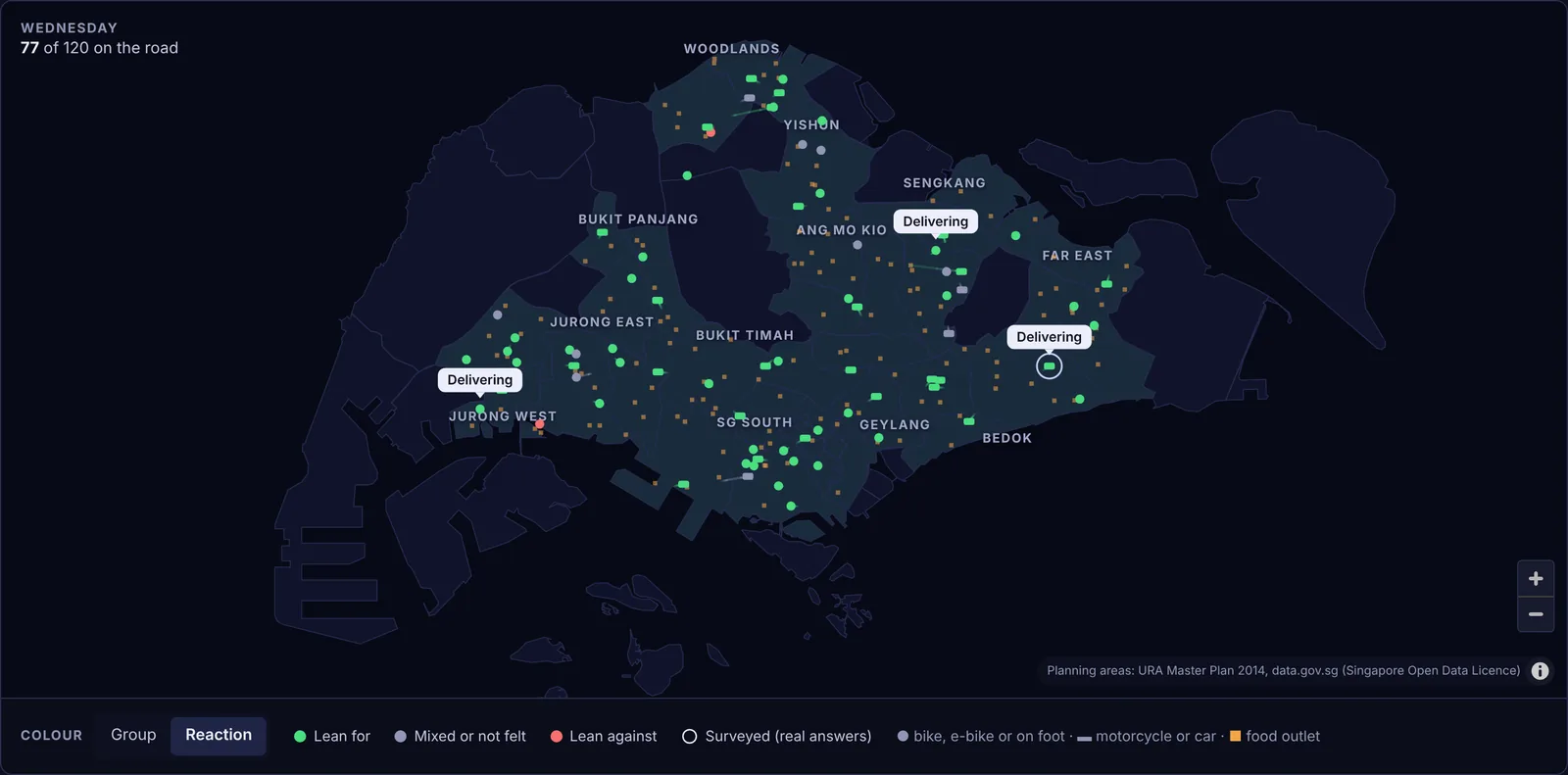
Press play to watch a day of food-delivery work across Singapore. Pick a proposal, switch on a bad-air day, and click any worker to see why they react the way they do.
57 of 120 gig workers on the road
+$1.50 per job started 11:00–14:00 on weekdays, paid for by cutting evening adjustments by $0.50 per job.
Click a dot on the map to see that worker's profile and why they react the way they do.
Simulated with sample worker-group values, for illustration. The private demo adds real, anonymised survey respondents and lets you ask each worker a question.
We are clear about what is live today and what is still being built.
Ask a plain-language question across past worker surveys. Answers use only what workers told you, cite the campaigns and show how many workers each figure rests on.
Watch a day of gig work on a map of Singapore, then test a proposal such as a lunch boost, distance pay or a rest rule, and see who leans for or against it and why.
Each profile labels every fact as observed, modelled or sample, so simulated detail is never mistaken for real feedback.
Names, phone numbers and IDs are removed or replaced with keyed codes before analysis. Only anonymised data reaches the models, handled under PDPA.
Weekly pay, active days, pay variability and the share of pay from incentives, built from anonymised earnings records.
Worker groups found from how people actually work, profiled with their own survey answers, with confidence and limits stated.
Simulated responses are compared with held-out real survey answers before they are used to support a decision.
Food delivery is live today. Ride-hailing, parcel delivery, home services and online freelance follow as their data is added.
Three packages that differ by how personalised the twins are and how much data sits behind them.
Log in and ask questions any time. Twins built from our data and our own trained models, refreshed with new data, with confidence tracked over time.
Best for: Quick answers and ongoing questions
Twins from our existing segment data and public data, plus extra tests for your question. Shows the direction, for example whether you pay less than competitors.
Best for: Early concepts, messages and survey pre-tests
Custom segments trained with your own data, plus a real-worker check. Tells you how much, for example by how much to raise pay. Exclusive to you.
Best for: Pricing, incentive and credit decisions
Each panel is built per client. Your data stays yours, anonymised and handled under PDPA. Prices vary by country.
Screens from the working demo. Synthetic workers use sample values; real survey answers stay inside the private product.
Each dot is a worker agent moving between food outlets and deliveries through the day. Colour shows their group or how they react to the proposal being tested.
Others simulate shoppers. We model hours, incentives, platforms and money decisions, starting from surveys and earnings records we collect with riders in Singapore and Malaysia.
Our Gig Workers Agent already serves delivery, ride-hailing and development-finance clients in Singapore, Malaysia, Mexico, Colombia and Bangladesh.
Twins are modelled from a verified sample and checked against surveys we already ran, segment by segment. Confidence is shown, and simulated answers are never presented as worker feedback.
CPF in Singapore and SOCSO in Malaysia shape how each segment behaves, so the twins react to the rules your workers actually live under.
A model of your target workers, segment by segment, built from real survey answers, earnings records and public data. You ask it how workers would react to a price, incentive, product or message, and each twin answers in its own words with a confidence level.
No. The twins are built from our field data and our own trained models, checked against surveys we already ran. Generic AI personas make gig workers look more financially literate than they are; ours are measured against real answers.
Yes, anonymised. We use worker IDs, never names, and handle data under PDPA. If you bring your own data for a customized panel, it stays yours and is used only for your twins.
No. Twins help you narrow down options before you pay for a field test. Results are always labelled as simulated and show where to confirm with real workers.
Singapore and Malaysia. Food delivery riders are covered end to end today. Ride-hailing drivers, parcel couriers and on-demand service workers are built per client on request.
Prices are on request and vary by country and package. Book a call and we will scope your question and suggest the right package.
Bring one real decision. A typical pilot takes five weeks: pick the decision, build the twins, run the test on three to five options, then confirm with a small real-worker check and a readout.
A 30-minute session: we scope your question and walk you through the twin console.